Blog
×
LANGUAGE
日本語
English
한국어
繁體中文
简体中文
ภาษาไทย
Tiếng Việt


Kyoto has so many temples, shrines and streets that first-time visitors in particular often get stuck on "where do I even start?" But rather than chasing famous sights at random, getting a rough grasp of the geography first makes planning much easier. This article looks at Kyoto by area and then covers the overall picture of the classic temples and shrines, seasonal highlights, transport and model itineraries. Use it as a map for building the skeleton of your trip.
The City of Kyoto's official "Kyoto City Official Travel Guide" introduces the city in 18 areas, such as "Gion & Kiyomizu-dera," "Saga & Arashiyama" and "Fushimi." At the planning stage, though, it is easier to think in five broader groupings.
Higashiyama is the area along the hills that run north–south on the east side of the city. Kiyomizu-dera, Gion, Yasaka Shrine, Nanzen-ji and the Philosopher's Path leading to Ginkaku-ji are all linked by walking and short bus rides. It is the most "walkable" area in Kyoto.
Rakuchu is the central city from Kyoto Station up to the Imperial Palace. It includes Nijo Castle, Kyoto Gyoen National Garden, Nishi Hongan-ji and Nishiki Market, and you can get around by subway and on foot. It is also a convenient place to stay, making it a natural base for your trip.
Rakuhoku is the north side of the city. It includes Kamigamo Shrine and Daitoku-ji, and further north Ohara and Kurama-Kibune. Because it is farther out, it is quieter and suits a more relaxed schedule.
Arashiyama-Sagano is on the west side of the city. Tenryu-ji and the Bamboo Grove cluster around Togetsukyo Bridge. From Kyoto Station you go by JR; from the Shijo area, by Hankyu or Randen.
Fushimi is in the south and is known for Fushimi Inari Taisha and its streets of sake breweries. It lies along the JR Nara Line and Keihan Railway and is close to Kyoto Station.
Of these five, you can comfortably cover basically one per day. Moving between areas takes more time than you might expect, so dividing your days as "today Higashiyama, tomorrow Arashiyama" is the least error-prone way to plan.
Kiyomizu-dera (Higashiyama) is said to have been founded in 778. It is the head temple of the Kita-Hosso school, and its principal image is the Eleven-faced, Thousand-armed Kannon Bodhisattva. It is known for the stage of its main hall jutting out over the slope, and the classic way to visit is to walk the approach along Sannenzaka and Ninenzaka.
Kinkaku-ji (at the gateway to Rakuhoku) is formally called Rokuon-ji and is one of the sub-temples of Shokoku-ji. Because the reliquary hall "Kinkaku" (Golden Pavilion) standing by the pond is so famous, the popular name has become far more widely used.
Ginkaku-ji (northern Higashiyama) is formally named Higashiyama Jisho-ji, and it too is a sub-temple of Shokoku-ji. Ashikaga Yoshimasa, the 8th shogun of the Muromachi shogunate, began building his Higashiyama villa in 1482; the Togu-do hall was completed in 1486, and the framework of the Kannon-den (Ginkaku, the Silver Pavilion) was raised in 1489.
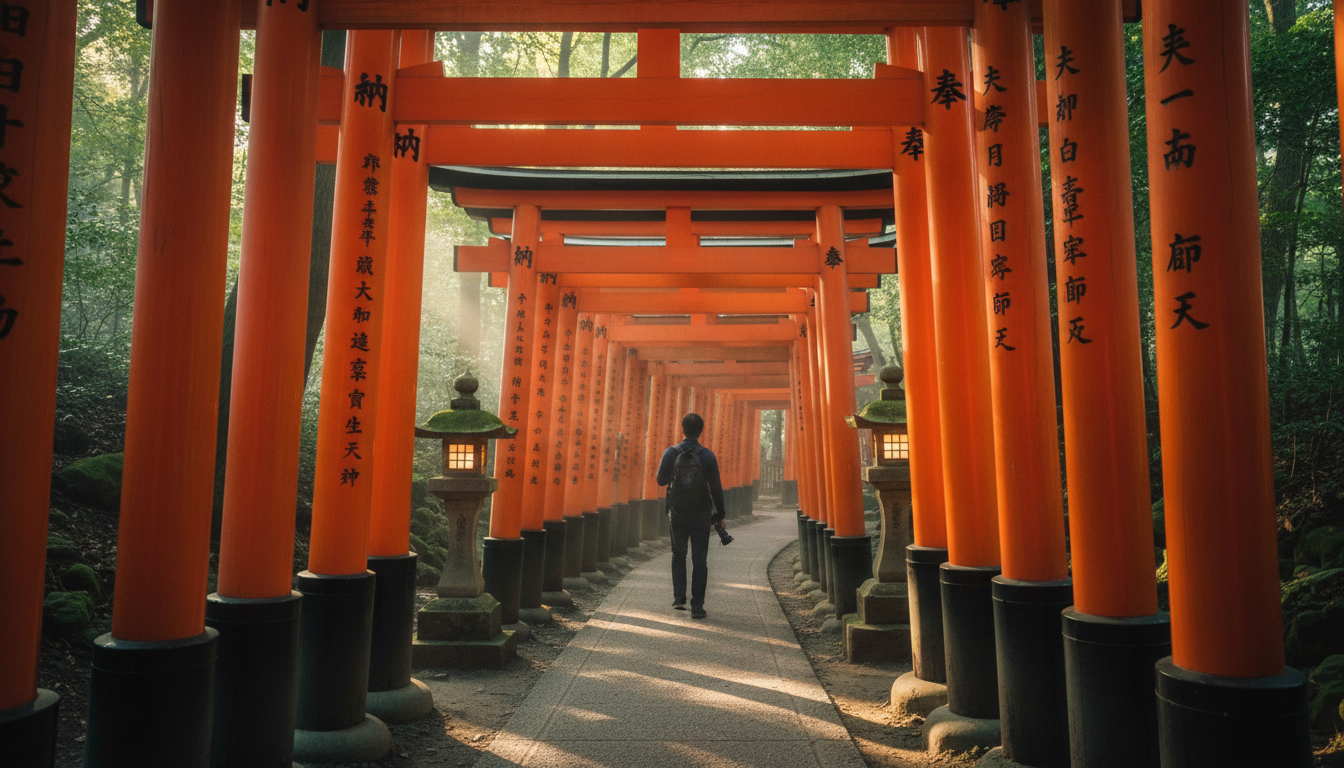
Fushimi Inari Taisha (Fushimi) is the head shrine of all Inari shrines in Japan, enshrining the Inari Okami deities. It is said to have been established on the first Day of the Horse in February 711. It is known for its approach lined with vermilion torii gates, but the pilgrimage path around Mt. Inari behind the main hall is about 4 km in a loop and takes about 2 hours. The time needed varies greatly depending on whether you only see the rows of torii and turn back, or climb the mountain.
Nijo Castle (Rakuchu) is a flatland castle built by Tokugawa Ieyasu in 1603 (Keicho 8) as his residence in Kyoto. The National Treasure Ninomaru Palace is the main highlight, and in 1867 (Keio 3), at the end of the Edo period, the 15th shogun Tokugawa Yoshinobu announced his intention to return power to the emperor at this castle.
Arashiyama has Tenryu-ji and the Bamboo Grove grouped around Togetsukyo Bridge. Tenryu-ji's Sogenchi Garden was the first to be designated a national Historic Site and Special Place of Scenic Beauty.
When you cannot narrow down where to go, World Heritage sites are a good clue. The "Historic Monuments of Ancient Kyoto (Kyoto, Uji and Otsu Cities)" were inscribed in 1994 and consist of 17 properties. They are not limited to Kyoto City but extend into Uji City and Otsu City.
Visiting them all at once is not realistic, but knowing which properties are in the area you are heading to gives your itinerary a clear logic. You can also build in one per day: Kiyomizu-dera for Higashiyama, Nijo Castle for Rakuchu, To-ji near Kyoto Station, and Tenryu-ji for Arashiyama.
Spring is cherry blossom season. Blooming varies with elevation and location within the city, so even in the same week some places are at their peak while others are still early. The whole city is crowded at this time, so visit the major temples and shrines early in the morning. The Kyoto City Official Travel Guide publishes a "Kyoto Tourism Comfort Map" that forecasts crowds based on location data, and notes that simply shifting your visit time can help you avoid the crowds.
Summer is the season of festivals. Gion Matsuri is the festival of Yasaka Shrine, with various rituals and events held throughout the month from July 1 to 31. The Yamaboko procession takes place on July 17 for the Saki Matsuri and July 24 for the Ato Matsuri. Yoiyama falls on July 14–16 for the Saki Matsuri and July 21–23 for the Ato Matsuri.
On the night of August 16, Gozan no Okuribi takes place. Starting with the Daimonji at 8:00 p.m., the fires are lit in order: Myoho at 8:05 p.m., Funagata at 8:10 p.m., Hidari Daimonji at 8:15 p.m., and Toriigata at 8:20 p.m.
The biggest thing to watch out for in summer is the heat. Partly because of its basin topography, Kyoto's summers are severely hot, so it is best to avoid itineraries with long walks in the middle of the day. For temples and shrines with many stone steps, or uphill pilgrimage routes like Mt. Inari, we recommend going in the morning or evening.
Autumn is the peak demand season for Kyoto tourism. According to the autumn leaves information on the Kyoto City Official Travel Guide, many spots in the city are at their best from mid- to late November, with Tofuku-ji, Eikan-do, Nanzen-ji, Kiyomizu-dera and Arashiyama all peaking at this time. Meanwhile, higher-altitude places such as Enryaku-ji on Mt. Hiei and Jingo-ji start turning color in early November, and some, like Shimogamo Shrine, reach their best in December. Even within "Kyoto in November" there is a range of several weeks, so match your destinations and dates to the foliage reports.
In winter the crowds settle down. Garden scenery becomes simpler, but you can take your time appreciating the architecture and sliding-door paintings. Watch out for the cold and early sunsets. Many temples and shrines close admission in the 4 p.m. hour, so you can visit fewer places in a day.
Kyoto has a dense city bus network that gets you close to many temples and shrines. However, city buses in the tourist season are prone to crowding and delays, and the Kyoto City Transportation Bureau itself recommends routes where you first travel close to major sights by train and then transfer to a bus. For Kiyomizu-dera, Kinkaku-ji, Ginkaku-ji and others, it also distributes leaflets showing routes from Kyoto Station with travel times.
During busy periods, there may be arrangements allowing free transfer from city buses to the subway. The details change from year to year, so it is reassuring to check the Kyoto City Transportation Bureau's information before your trip.
On day 1, go through Higashiyama from south to north. Walk Kiyomizu-dera and its approach, continue to Yasaka Shrine and Gion, and spend the evening eating around Shijo. Almost all the movement is on foot, so it is a day where timing is easy to predict.
On day 2, head to Fushimi Inari Taisha. Visit in the morning and adjust your time by how far up Mt. Inari you climb. In the afternoon, return to Kyoto Station and add places near the station such as To-ji or Nishi Hongan-ji, so you can use your time comfortably until you leave.
Keep days 1 and 2 the same as above, and add Arashiyama on day 3. The basic plan is to arrive in Arashiyama by train in the morning and walk Togetsukyo Bridge, Tenryu-ji and the Bamboo Grove.
You can also swap day 3 for Rakuchu and Rakuhoku: spend the morning at Nijo Castle, then in the afternoon visit Kinkaku-ji and go on to Ryoan-ji or Ninna-ji. However, because bus travel is involved, timing is harder to predict, and in busy periods the Arashiyama plan is more reliable.
Opening hours differ by site and also change with the season and events. As a general trend, many temples and shrines start admission around 9 a.m. and finish between 4 p.m. and 5 p.m. Kinkaku-ji is open from 9 a.m. to 5 p.m., and Nijo Castle admits visitors from 8:45 to 16:00 and closes at 17:00. On the other hand, some shrines such as Fushimi Inari Taisha have no closing gate and can be visited at any time.
Note that "closing time" and "last admission" are different. Admission often closes about 30 minutes before the gates shut, so if you arrive at the last minute you may not get in. For each temple or shrine, allow 30 minutes to an hour just to walk around the grounds.
Admission fees also differ by site, and special openings and evening illuminations may have separate fees. Because amounts can change, this article does not list individual fees. Please check each temple's or shrine's official website, together with whether there are special openings, what areas are open, and closed days (Nijo Castle is closed December 29–31).
Kyoto is not a city you can see in one visit. Narrow down the area, match the season, and choose your transport. If you keep these three points in mind, you should be able to grasp the outline of Kyoto well even in a limited number of days.
*The information in this article is current as of August 2026. Opening hours, admission fees and areas open to the public are subject to change. Please check each temple's or shrine's official information before you go.
 Facebook
 X (Twitter)
 LINE